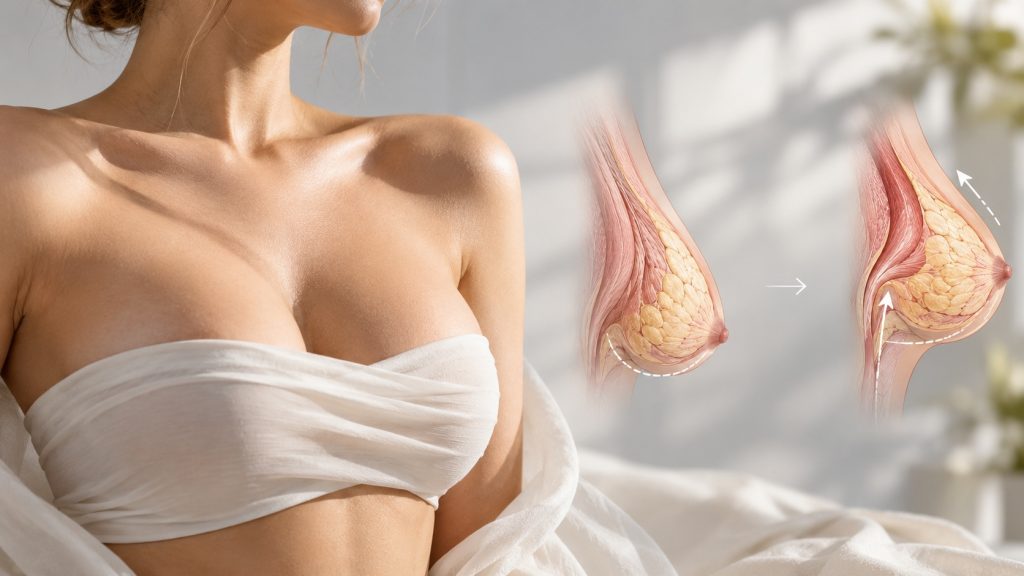
Learn how implant-free breast aesthetics can reshape existing breast tissue to restore lift, contour and upper-pole fullness without implants.
Breast augmentation and silicone implants have been closely linked for decades. When someone wanted more fullness, particularly in the upper breast, adding an implant was often part of the discussion. But it is not the only way breast volume can be approached.
Some patients want a lifted, fuller shape without placing a foreign material in their body. Others already have enough breast tissue; their concern is where that tissue sits. For them, techniques such as breast autoaugmentation and autoprosthesis raise a different possibility: rather than adding volume, can the volume that is already there be put to better use?
Why Are More Patients Exploring Breast Aesthetics Without Implants?
There is no single reason. One patient may simply prefer the idea of using her own tissue. Another may be uncomfortable with having an implant. And for many women, increasing breast size is not really the objective in the first place. What they want is to correct sagging and regain some of the shape lost after pregnancy, breastfeeding, weight changes or ageing.
Volume and position are easy to confuse here. A breast can still contain adequate tissue while much of that tissue has settled into the lower pole. The upper breast then looks relatively empty, even though overall breast volume has not necessarily disappeared.
Seen from that perspective, the question changes. Instead of asking what needs to be added, it becomes reasonable to ask whether the existing tissue can be redistributed.
What Does Implant-Free Breast Aesthetics Mean?
Implant-free breast aesthetics is a broad term for surgical approaches intended to improve breast position, shape or fullness without inserting a silicone breast implant. Depending on the patient’s anatomy and expectations, that may involve mastopexy, internal tissue reshaping or an autoaugmentation technique.
There is an important limitation to understand from the outset. An implant-free procedure does not automatically reproduce what an implant can do. Your own tissue is a finite source of volume, and the amount available, where it sits, its quality and the elasticity of the surrounding skin all affect what can realistically be achieved.
Breast Lift vs. Breast Augmentation Without Implants
A conventional breast lift, known medically as mastopexy, mainly deals with position and excess skin. The nipple-areola complex can be repositioned and the breast envelope reshaped, giving the breast a higher contour.
Augmentation answers a somewhat different need because its purpose is to add volume. This is why mastopexy has traditionally been combined with an implant when a patient wants a lift together with a more pronounced increase in upper-pole fullness.
Autoaugmentation approaches work differently. There is no separate implant supplying the additional volume. Instead, breast tissue that is already present is reshaped and repositioned so that it contributes more effectively to fullness and projection.
Using Your Own Breast Tissue Instead of a Foreign Material
The basic idea is fairly intuitive, even though the surgery itself is technically more complex. Tissue in the lower part of the breast does not always have to be viewed simply as tissue that needs to be removed. In selected patients, some of it can be preserved and repositioned.
This is autologous tissue: tissue that belongs to the patient’s own body. When the anatomy is suitable, it can contribute to projection, internal support and the contour of the upper breast.
An implant introduces a new source of volume. Autoaugmentation has to work with the volume already available. That difference shapes almost every discussion about who may or may not be a suitable candidate.
What Is an Autoprosthesis in Breast Surgery?
An Autoprosthesis uses the patient’s own breast tissue as an internal source of volume and support rather than relying on a conventional breast implant. During surgery, that tissue is reshaped and repositioned to contribute to the new breast contour.
This concept is particularly relevant when a patient has enough natural breast tissue but also has breast ptosis, or sagging, together with reduced fullness in the upper pole. In other words, the tissue exists; its distribution is part of the problem.
How Autoprosthesis Uses Existing Breast Tissue
Pregnancy, breastfeeding, ageing and substantial weight changes can alter where breast tissue sits. Over time, more tissue may settle in the lower breast while the upper portion begins to look comparatively empty.
An autoprosthesis approach makes structural use of some of that existing tissue. Rather than treating all redundant lower-pole tissue as something to remove, selected tissue can be retained and incorporated into the reshaping of the breast.
There are limits, naturally. Repositioning tissue cannot create an unlimited amount of new volume. A patient seeking a substantial increase in breast size may therefore have goals that an own-tissue technique alone cannot meet.
What Is the Dual-Plane Autoprosthesis Technique?
The Dual-Plane Autoprosthesis technique is one specific approach within this area. It uses a dermoglandular flap created from the patient’s breast tissue and positions it in the subpectoral plane, beneath the pectoralis major muscle.
Here, tissue redistribution and anatomical support are used together. Tissue originating from the lower pole provides volume, while its subpectoral placement forms part of the internal support strategy.
The technique was described by Umut Zereyak and Onur Aksoy in a 2026 peer-reviewed paper published in Aesthetic Plastic Surgery. Their retrospective study covered 47 patients who underwent mastopexy or reduction mammoplasty using the modified inferior-pedicle approach. Ultrasound assessment at 12 months showed a statistically significant improvement in upper-pole fullness.
Those findings provide clinical evidence worth considering, but they need to be read in context. This was a retrospective Level IV study involving 47 patients, not a large comparative trial. Broader studies and longer follow-up would give a clearer picture of how the technique compares with other established approaches over time.
How Can Your Own Tissue Create Upper-Pole Fullness?
Upper-pole fullness simply refers to volume in the part of the breast above the nipple. When that volume decreases, the breast may look deflated at the top even though a considerable amount of tissue remains lower down.
A skin lift alone does not necessarily address that distribution of volume. Internal reshaping can therefore become just as relevant as lifting the external breast envelope.
Repositioning Lower-Pole Breast Tissue
During tissue-based autoaugmentation, selected dermoglandular tissue from the lower breast can be preserved and moved to a position where it contributes more to projection and upper-pole volume.
With the Dual-Plane approach, part of this tissue is placed in a subpectoral plane. Put more simply, the patient’s existing tissue is used as the internal volume source instead of inserting silicone for that purpose.
The Role of Pectoral Muscle Support
The pectoralis major muscle is more than an anatomical landmark in this technique. Muscle coverage forms part of the support system for the repositioned tissue.
That feature separates the Dual-Plane Autoprosthesis concept from techniques in which reshaped glandular tissue remains entirely in more superficial planes.
The published technique is designed to support projection, increase superior fullness and limit recurrent descent of the lower pole. It is still surgery performed on living tissue, though. Anatomy, tissue quality, healing and the natural changes that occur with time can all influence the eventual result.
Autoprosthesis vs. Breast Implants: What Are the Key Differences?
It is tempting to frame this as a simple choice between two competing procedures. In practice, they overlap in some goals but do not solve exactly the same problems. Their indications are different too.
| Factor | Own-Tissue Autoprosthesis | Breast Implant |
|---|---|---|
| Volume source | Existing breast tissue | Silicone or saline implant |
| Foreign implant | No | Yes |
| Potential size increase | Limited by available tissue | Volume can be selected more independently |
| Upper-pole fullness | Created by tissue redistribution | Created largely by implant volume and position |
| Best suited to | Selected patients with sufficient existing tissue | Patients who may require or prefer additional volume |
| Future considerations | Natural tissue continues to age and change | Natural tissue changes plus implant-specific considerations |
Natural Tissue vs. Silicone Implant
The clearest distinction is where the volume comes from. With an autoprosthesis, it comes from breast tissue the patient already has. Implant augmentation adds a manufactured device to provide volume that was not previously there.
A no-implant, or “Noimplant”, approach consequently avoids problems that specifically depend on the presence of a breast implant. It should not be confused with risk-free surgery. Mastopexy and autoaugmentation are still surgical procedures, with scars, healing considerations, possible complications and individual limitations that need to be discussed with a qualified plastic surgeon.
Shape, Volume and Upper-Pole Fullness
An implant can add volume beyond the amount naturally present in the breast. Own-tissue surgery cannot do that. This sounds obvious, but it is one of the most useful distinctions for setting realistic expectations.
If someone already has sufficient breast tissue and is mainly unhappy with its position, redistribution may be worth discussing. If the starting breast volume is low and the goal is a substantial size increase, the conversation is quite different.
Implant-Related Considerations
Without an implant, implant-specific complications such as implant rupture or capsular contracture do not arise. General risks associated with breast surgery, however, still remain.
There are aesthetic trade-offs as well, particularly around how much additional volume can be achieved and how predictable that volume may be. For that reason, “implant-free” should not automatically be read as “better.” What matters is whether the technique fits the patient’s anatomy and expectations.
Who May Be Suitable for Implant-Free Breast Aesthetics?
Not everyone has enough suitable tissue for this type of reshaping. Patient selection is central to the concept.
Broadly speaking, own-tissue autoaugmentation may be considered for someone with breast ptosis who still has sufficient natural breast volume and wants a lift with greater upper-pole fullness without an implant. That general description is not enough to determine candidacy; a physical examination is needed.
Breast Ptosis and Loss of Upper-Pole Volume
Breast ptosis describes descent of the breast and/or nipple from its previous position. Its degree varies, and factors such as pregnancy, breastfeeding, weight fluctuation, ageing, skin quality and genetics can all contribute.
Loss of upper-pole volume often appears alongside ptosis. So a patient’s concern may not simply be that her breasts sit lower than before. She may also notice that the area above the nipple has become flatter or less full.
Why Existing Breast Tissue Matters
Autoaugmentation needs tissue to reshape. When enough breast tissue is available, a surgeon may be able to reposition some of it and use that tissue to support a fuller contour.
This also explains why two patients asking for a similar appearance can receive different surgical recommendations. Tissue volume, skin elasticity, breast footprint, degree of ptosis and body proportions are not interchangeable from one person to another.
When an Implant-Free Technique May Not Be Suitable
If the goal is a substantial increase in breast size, the existing tissue may simply not provide enough volume. Very limited breast tissue or certain anatomical characteristics can also make an own-tissue approach unsuitable.
The decision is not based on breast shape alone. Previous breast surgery, general health, smoking, medications and individual surgical risk can affect planning as well. A preferred cup size or a collection of reference photographs cannot answer those questions on its own.
How PureOwn Approaches Implant-Free Breast Aesthetics
pureown focuses on implant-free breast aesthetics through the Zereyak Autoprosthesis approach developed by plastic surgeon Umut Zereyak. The underlying idea is not simply to reproduce conventional augmentation without silicone. It centres on preserving, restructuring and supporting the patient’s existing breast tissue in a different anatomical position.
The Dual-Plane Autoprosthesis technique has also been described in peer-reviewed clinical literature. Zereyak and Aksoy’s study was published in Aesthetic Plastic Surgery in July 2026 and reported on 47 patients treated between 2018 and 2023. The researchers assessed upper-pole fullness at 12 months and included patient-reported outcome measures in their evaluation.
For someone researching the procedure, the publication adds useful context because it documents both the surgical method and measured outcomes. It should not be treated as a promise of what will happen in every case. Individual breast anatomy varies considerably, and further evidence remains useful when assessing newer or modified surgical techniques.
What Should You Ask Before Considering an Implant-Free Breast Procedure?
A productive consultation is less about asking which operation is “best” and more about finding out what a particular procedure can realistically accomplish with your anatomy. A few questions can make that conversation much clearer:
- Do I have enough natural breast tissue for autoaugmentation?
- How much upper-pole fullness could realistically be created from my existing tissue?
- Will the procedure increase my breast size, or mainly redistribute existing volume?
- Where will the scars be located?
- How does my degree of ptosis affect the surgical plan?
- What are the risks and possible complications?
- How might pregnancy, ageing or future weight changes affect the result?
- What alternatives should I consider based on my anatomy?
It is also reasonable to ask how much experience the surgeon has with the specific technique being discussed and what evidence supports it. Limitations deserve a place in that conversation too. A useful consultation should make those clear rather than focusing only on potential benefits.
The Future of Natural-Tissue Breast Aesthetics
Breast surgery does not always begin with a choice of implant shape or size. For patients who already have enough breast volume, tissue preservation, redistribution and internal support can become part of the discussion as well.
Perhaps the most useful change is the question this allows a patient to ask: if upper-pole fullness has been lost, does it necessarily have to be replaced with silicone, or can some of the existing tissue be repositioned?
There is no universal answer. Implants remain relevant for many patients, while own-tissue surgery has anatomical limits and is not appropriate for everyone. What it does provide is another route to consider, particularly when the objective is redistribution rather than a large increase in breast volume.
If you are exploring whether existing breast tissue could contribute to the lift and upper-pole volume you want, information about Implant-Free Breast Aesthetics can help you understand how the approach works before discussing your anatomy, expectations and surgical options with a qualified plastic surgeon.
Frequently Asked Questions About Implant-Free Breast Aesthetics
1. Can breasts be made fuller without implants?
Yes, in selected patients. Existing breast tissue can sometimes be reshaped and repositioned to improve projection and upper-pole fullness. How much can be achieved depends largely on the amount and quality of tissue already present.
2. What is breast autoaugmentation?
Breast autoaugmentation uses the patient’s own breast tissue to help create or restore volume during breast reshaping or lifting surgery. Existing tissue is redistributed rather than adding volume with an implant.
3. What does autoprosthesis mean?
In breast surgery, autoprosthesis refers to using the patient’s own tissue as an internal source of volume and support. The reshaped tissue performs part of the structural role that might otherwise be provided by a manufactured implant.
4. Is an autoprosthesis the same as a breast implant?
No. A breast implant is a manufactured device placed in the breast to add volume. An autoprosthesis is formed from tissue the patient already has, which means the available volume is naturally limited by her anatomy.
5. Can an implant-free breast lift increase cup size?
Not necessarily. Autoaugmentation redistributes existing volume rather than creating new breast tissue. A change in shape and upper-pole fullness can alter the overall appearance of the breast, but someone seeking a substantial size increase needs to discuss whether an own-tissue procedure can realistically achieve that goal.
6. What is upper-pole fullness?
Upper-pole fullness is the volume in the upper portion of the breast, above the nipple. This area can become flatter after pregnancy, breastfeeding, weight loss or ageing, giving the breast a more deflated appearance.
7. Who is a good candidate for breast autoaugmentation?
Potential candidates generally have enough existing breast tissue to redistribute and are concerned about sagging, upper-pole volume loss or both. Suitability still has to be assessed individually because anatomy, tissue quality, health and expectations all affect the surgical plan.
8. Does implant-free breast surgery leave scars?
Yes. Implant-free does not mean incision-free. The scar pattern depends on the operation and the amount of lifting required, so it should be discussed as part of surgical planning.
9. Does using your own breast tissue eliminate surgical risks?
No. It avoids complications that specifically depend on having a breast implant, but mastopexy and autoaugmentation remain surgical procedures. Scarring, healing problems, other possible complications and individual risk factors still need to be considered.
10. How long do results from an own-tissue breast lift last?
There is no fixed lifespan that applies to every patient. Natural breast tissue continues to change with ageing, gravity, pregnancy and weight fluctuations. Tissue quality and surgical technique can also influence how the breast changes over the years.
11. Can natural breast tissue replace an implant completely?
For some patients, it can perform part of the role that an implant might otherwise play, particularly in restoring projection and upper-pole fullness. It cannot create unlimited additional volume, though. Whether it can meet a patient’s goals depends heavily on her starting anatomy and desired result.
12. How do I know whether implant-free breast aesthetics is suitable for me?
A clinical assessment is needed to answer that reliably. The surgeon has to evaluate breast volume, skin elasticity, tissue quality, degree of ptosis, previous operations, general health and your expectations before deciding whether an implant-free technique is appropriate.