
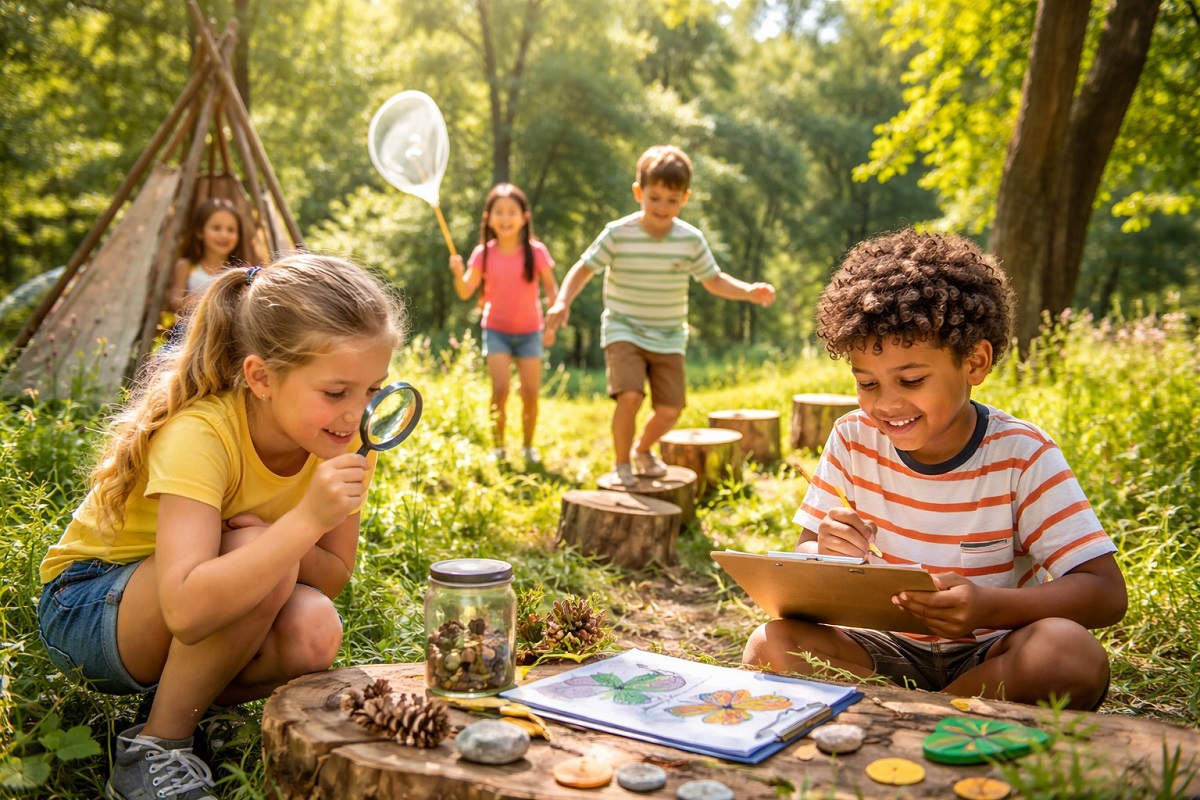
Discover practical, playful, and meaningful outdoor activities that build curiosity, movement, teamwork, and environmental awareness in children.
Children learn in all sorts of ways, but honestly, some of the best learning happens when they are not sitting still. Give a child a patch of grass, a few leaves, a question to solve, and a little freedom, and suddenly learning stops feeling like a task. It becomes something alive. That is exactly why educational outdoor play matters so much. It blends movement, imagination, curiosity, and social interaction in a way few indoor activities can match.
When families, teachers, and caregivers search for educational outdoor games for kids, they are usually looking for more than “something fun to do outside.” They want activities that help children think, observe, cooperate, and grow. They want ideas that are simple enough to try without turning the backyard, playground, or school garden into a full-scale event plan. Fair enough. Not every useful activity needs fancy equipment.
In my view, the most effective outdoor education games are the ones that feel effortless to children but intentional to adults. A child may think, “I’m jumping on number cards,” while the adult quietly notices the child is practicing math, impulse control, coordination, and listening skills all at once. That is the sweet spot.
Why Outdoor Learning Works So Well for Children
Outdoor learning is powerful because it engages the whole child. Indoors, children often depend heavily on verbal instruction. Outside, they use their eyes, ears, hands, balance, and instincts. They run, sort, compare, build, ask questions, and test ideas in real time. It feels natural because, well, it is.
There is also something about open-air spaces that changes a child’s energy. Many children become more expressive outdoors. They speak more freely, move more confidently, and show problem-solving skills that might not appear during desk-based tasks. You see this all the time in mixed-age groups. Even the quieter children often find their rhythm outside.
Another reason outdoor activities matter is that they support multiple areas of development at once. A single game can strengthen language, memory, fine motor skills, social communication, and emotional regulation. That overlap is gold, especially in early childhood. It is one reason educators keep returning to play-based learning again and again.
What Makes a Good Educational Outdoor Game?
Not every outdoor activity automatically becomes educational. For a game to truly support learning, it helps if it includes a clear purpose, some room for thinking, and enough flexibility to adapt to different ages. A great game does not need to feel academic, but it should encourage children to notice, respond, decide, or create.
Usually, the strongest activities share a few qualities:
- They involve active participation rather than passive watching.
- They encourage curiosity and conversation.
- They can be adjusted for younger and older children.
- They connect play with a real skill such as counting, classifying, observing, or communicating.
- They leave space for joy. That part is not optional.
And yes, a bit of mess is normal. A little dirt on the shoes, some leaves in the pockets, a child who insists their stick house is “a luxury squirrel hotel” — that usually means the activity is going quite well.
The Learning Benefits Behind Educational Outdoor Games for Kids
Before getting into specific game ideas, it helps to understand what children are actually developing during this kind of play. Adults sometimes underestimate outdoor games because they look simple from the outside. But under the surface, a lot is happening.
Cognitive Development
Many outdoor activities support attention, sequencing, memory, categorization, and problem-solving. When children follow multi-step directions, guess which season matches a clue, or build something stable using natural materials, they are training the brain to process information in flexible ways.
Motor Development
Running, jumping, balancing, throwing, bending, collecting, carrying, and arranging objects all strengthen gross and fine motor skills. Games played on grass, soil, or uneven natural surfaces also challenge coordination and body awareness in a healthy way.
Language Growth
Outdoor games create easy reasons to talk. Children label objects, explain choices, repeat instructions, ask for turns, describe what they notice, and use new vocabulary in context. That matters a lot. Vocabulary learned through action tends to stick better than words learned in isolation.
Social and Emotional Skills
Taking turns, coping with mistakes, negotiating rules, helping a teammate, and managing excitement are all part of group play. Some children learn confidence outside. Others learn patience. Many learn both, though not always on the same day.
Environmental Awareness
This may be the most special part. A thoughtful environmental education game helps children understand that nature is not just scenery. It is a system full of relationships, patterns, and living things that deserve attention and care. That lesson, when introduced gently and early, can stay with them for years.
15 Meaningful Outdoor Education Games Children Actually Enjoy
Below are fifteen practical ideas inspired by nature-based learning, early childhood practice, and play-centered teaching. Each one can be adapted for families, preschools, kindergartens, primary classrooms, or informal community groups.
1. Letters on the Ground
This is a brilliant activity for imagination and early literacy. Place large letter cards on the ground, spaced out enough for children to move between them. Then ask open-ended questions like, “What animal would you like to be today?” or “What is something that makes you smile?” Children move to the letter that matches the first sound of their answer.
It works because it turns abstract letter recognition into something physical. Younger children practice sound awareness, while older children can explain their choices in full sentences. The movement keeps the pace lively, and the open-ended questions encourage self-expression instead of one-word answers.
2. The Wolf or the Lamb?
Draw a line on the ground and assign one side as “wolf” and the other as “lamb.” Ask children yes-or-no questions related to science, nature, or general knowledge. They choose a side based on what they think is correct. Then comes the fun part: those on the correct side become lambs and run, while the others try to tag them as wolves.
This game mixes knowledge recall with quick decisions and physical response. It is one of those activities where children barely notice they are reviewing information because the chase element makes everything feel fast and fun.
3. Grab the Stones
Paint simple stones and use them as counting tools. A child tosses the stones lightly; those landing on the marked side can be collected if the child answers a number or language question correctly. You can adapt the question type based on age: counting, color naming, English phrases, simple addition, even category naming.
The tactile quality of stones makes the game feel grounded and real. For some children, that sensory element is incredibly helpful. It supports counting, focus, and listening in a very natural way.
4. The Well Game
Dig a small target hole in soft ground or create one using a bucket sunk low into sand. Mark a throwing line nearby. Children toss lightweight balls and try to land them close to the line, then aim for the hole in later rounds to earn points. You can add creativity by letting children decorate their balls or invent team names.
This kind of game strengthens hand-eye coordination, force control, and concentration. It is also a good example of how simple ground games for children can still offer real developmental value without needing elaborate materials.
5. Food Chain Tag
Assign roles such as plant, herbivore, and carnivore. Plants remain within a marked zone, herbivores try to tag plants, and carnivores chase herbivores. When someone is tagged, they switch role according to the rules. After the game, gather the group and talk about what happened. Who depended on whom? What happened when one group changed in size?
This is a very effective environmental education game because it helps children experience ecosystem relationships with their bodies, not just through explanation. And once children feel a concept in motion, they tend to understand it more deeply.
6. Season Circle
Mark four corners as spring, summer, autumn, and winter. Call out clues such as “Leaves are falling,” “The weather is freezing,” or “Flowers begin to bloom.” Children run to the matching season corner. You can make it harder by using less obvious clues or asking children to invent clues of their own.
This game supports memory, classification, and listening skills. It is especially helpful for children who learn best through movement and repetition rather than worksheets.
7. Flying Words
Stand in a circle with a ball. The leader says a word such as “forest” and throws the ball to a child, who must say a related word like “tree,” “bird,” or “leaf” before tossing it to someone else. Add a countdown if you want to build speed and focus.
This activity supports vocabulary growth, semantic connection, and social participation. It can be themed around nature, weather, animals, colors, or classroom topics. Simple? Yes. Effective? Also yes.
8. Secret Codes
Write instructions on slips of paper, making two copies of each. Children each draw one instruction and perform it silently, trying to find the person doing the same action. Commands can include things like “Hop twice and touch a tree” or “Take three steps and crouch by a flower.”
It is playful, a little mysterious, and perfect for developing listening, sequencing, and observational awareness. Children also love the detective-like feeling of trying to find their matching partner.
9. Word Station
Create four stations using categories such as fruits, animals, objects, and colors. Call out a letter. Children think of a word that begins with that letter and run to the correct station while saying it aloud. Anyone who gets stuck can pause in the center and listen to others before trying again in the next round.
This works beautifully for vocabulary retrieval and category thinking. It also gives energetic children a chance to combine language with full-body movement, which, to be honest, often improves engagement a lot.
10. Imaginary Animal Path
Set up a simple path with chalk, rope, or natural markers. Children pick animal cards and move along the path like that animal: hopping like a frog, slithering like a snake, flapping like a bird. At the end, ask a question such as, “What would this animal say if it could talk?”
This blends physical movement with empathy and imagination. It is playful on the surface, but underneath, children are practicing symbolic thinking and perspective-taking. That combination matters more than it may seem.
11. Jumping Numbers
Place large number cards on the ground. Call out a simple math problem, and children jump or run to the correct answer. To make it more advanced, use subtraction, number comparison, or even simple word problems. For younger children, just ask them to find a number you name.
This is one of the most adaptable educational outdoor games for kids because it can work for preschool number recognition or early primary math fluency. It is active, direct, and easy to reset between rounds.
12. Shadow Tracking Race
Give each child a stick and help them place it upright in the ground. At different times of day, children trace the shadow and compare how it changes. Which shadow is longer? Which direction is it pointing now? Why did it move?
This game quietly introduces scientific observation, time awareness, and the relationship between the sun and shadows. It is a lovely example of how an environmental education game teaching child development can support both scientific thinking and patient observation at the same time.
13. Nature’s Architects
Show children examples of nests, webs, tunnels, or shelters built by animals. Then invite them to create small “homes” for a chosen creature using only fallen natural materials such as leaves, sticks, grass, and pinecones. Once built, test whether the structure stays together in a breeze or under a light sprinkle of water.
This activity is fantastic for design thinking, creativity, and cause-and-effect reasoning. It also gently introduces children to the idea that animal homes are purposeful, not random. That shift in thinking can lead to deeper respect for nature.
14. Living or Non-living
Ask children to collect or identify one living thing and one non-living thing from the environment. Then let them explain their choices. Is the leaf living now, or did it come from something living? Is water alive? Why or why not? These questions often lead to surprisingly rich discussions.
This game builds classification skills and early science understanding. More importantly, it encourages children to observe carefully instead of guessing quickly.
15. This One Is Long
Invite children to gather fallen natural objects of different lengths, such as twigs, dry grass, or leaves. Place them on a sorting line from shortest to longest. Then ask children to compare, estimate, and measure using string, rulers, or hand spans.
It may look simple, but this is one of those activities that quietly teaches comparison, prediction, measurement, and reasoning. It is also calm, collaborative, and ideal for children who prefer focused tasks over highly competitive games.
How to Match the Right Game to the Right Age
One mistake adults sometimes make is choosing a good game but missing the developmental level. A game that feels exciting to a six-year-old may confuse a three-year-old. On the other hand, an activity that feels too basic can make older children switch off pretty quickly.
For younger children, aim for games with simple instructions, visible actions, and quick feedback. Matching, moving, naming, collecting, and pretending usually work well. For older children, you can add strategy, memory, more complex questions, or reflection afterward.
A good rule? Keep the structure simple and the thinking flexible. Children do not need complicated rules to experience deep learning.
Tips for Running Outdoor Education Games Smoothly
Even the best game can fall flat if the setup feels chaotic. A few practical decisions make a big difference:
- Explain the game in one short round first, then start.
- Show, don’t just tell. Demonstrations help a lot.
- Keep materials visible and easy to reach.
- Use short turns to reduce waiting time.
- Offer variations for children with different confidence levels.
- End with one small question: “What did you notice?” or “What made this tricky?”
That final reflection matters more than people think. It helps children connect the fun of the activity with the learning inside it.
Why Nature-Based Learning Deserves a Bigger Place in Childhood
Children today often move between very structured environments. School schedules, indoor routines, screens, car rides, homework, clubs. None of these are inherently bad, of course, but they can leave less room for open-ended discovery. Outdoor play restores some of that balance.
Nature-based learning invites children to pay attention. To patterns. To textures. To living things. To weather. To change. Those experiences build not only knowledge, but also affection. And children are much more likely to protect what they have learned to notice.
That is why a strong environmental education game is not only about facts. It is about relationship. A child who has watched ants carry crumbs, compared leaf sizes, followed shadows, and built a tiny shelter from branches begins to feel that the natural world is worth caring about. Not as a slogan. As something real.
A Thoughtful Resource for Families and Educators
If you want more ideas in this area, especially activities that combine movement, environmental awareness, and child-friendly learning design, it is worth taking a look at envikid.com. The platform focuses on helping adults create meaningful nature-based experiences for children, and that practical angle makes a real difference. Rather than offering generic activity suggestions, it leans into learning, development, and connection with the environment in a way that feels useful and grounded.
Final Thoughts
Educational outdoor play does not need to be complicated to be powerful. A few cards, a ball, some stones, a patch of ground, and a thoughtful prompt can open the door to language learning, math practice, science discovery, teamwork, and environmental awareness all at once. That is a pretty amazing return on something as simple as stepping outside.
Bence the best outdoor games are the ones children ask to play again without realizing how much they learned the first time. If that happens, you have done something right. And if one of these ideas sparks a new routine in your home, classroom, or play space, even better.
Try a few, adapt them to your group, and see what clicks. Then share the ideas with another parent, teacher, or caregiver, because good play tends to spread in the nicest possible way.